
Tennessee · Over $6 Million
Tennessee Multifamily Loans
Select Commercial arranges Tennessee multifamily loans, with rates as low as 6.14%, up to 80% LTV and non-recourse agency options. We compare Fannie Mae, Freddie Mac, FHA/HUD and CMBS. For loans under $6 million, see Tennessee apartment loans. See current rates on every loan type we offer.
Get a Free QuoteFinancing Options in Tennessee
Tennessee apartment, multifamily and commercial properties each have dedicated financing. Pick the page that matches your property:
Financing more of the state? See Tennessee apartment loans and Tennessee commercial mortgages.
Financing in another state? Explore our apartment loans, multifamily loans and commercial mortgages nationwide.
Tennessee Multifamily Loan Rates
Rates updated as of October 22, 2026
| Loan Type | Rate* | Max LTV |
|---|---|---|
| 5 Year Fixed | 6.14% | Up to 80% |
| 7 Year Fixed | 6.17% | Up to 80% |
| 10 Year Fixed | 6.21% | Up to 80% |
- Streamlined underwriting for institutional multifamily
- Cash-out refinances are acceptable
- Interest-only and non-recourse options
- Minimum 1.25x debt-service-coverage ratio
Tennessee Apartment Loans
For smaller apartment building loans, under $6 million
Rates last updated October 22, 2026. Rates and maximum LTV shown represent our best-case pricing scenarios. Actual rates, LTV, and loan terms are subject to underwriting approval and may vary.
Tennessee Apartment Building Loans
Not every Tennessee apartment property is over $6 million, and we finance smaller buildings too. For 5+ unit Tennessee apartment properties from $1,500,000 to $6 million, see our Tennessee apartment loans page for Fannie Mae Small Loan, Freddie Mac SBL, bank and credit union options.
Compare Tennessee Large-Balance Programs
As a broker we place your large-balance Tennessee multifamily loan with the right capital source. Typical starting points for properties over $6 million:
| Program | Typical rate* | Max leverage | Best for |
|---|---|---|---|
| Fannie Mae DUS | 6.14% | Up to 80% | Non-recourse, fixed to 30 yrs |
| Freddie Mac | 6.17% | Up to 80% | Non-recourse large-balance |
| FHA / HUD | 6.74% | Up to 85% | Highest leverage, 35-yr amortization |
| CMBS / conduit | 7.03% | Up to 75% | Non-recourse, flexible underwriting |
Most large-balance lenders look for a debt-service-coverage ratio (DSCR) of at least 1.25x. For properties under $6 million, see our Tennessee apartment loans.
Rates last updated October 22, 2026. Rates and maximum LTV shown represent our best-case pricing scenarios. Actual rates, LTV, and loan terms are subject to underwriting approval and may vary.
2026 Tennessee Multifamily Investment and Lending Outlook
Tennessee shows the widest gap in the country between what the market data says and what stabilized owners are actually collecting, and Memphis is the extreme case.
Cushman & Wakefield reported second-quarter 2026 whole-market vacancy of 14.5% in Memphis at $1,210 asking rent, 10.3% in Nashville at $1,722, and 9.1% in Knoxville at $1,549. Mid-America Apartment Communities, reporting its own stabilized same-store portfolio for the same quarter, recorded 94.6% physical occupancy in Memphis at $1,422 effective rent and 95.3% in Nashville at $1,654. A single owner’s same-store portfolio is a narrower universe than a market-wide stabilized survey, so it will not match one exactly.
Memphis at 14.5% whole-market vacancy and 94.6% stabilized occupancy is a nine-point spread. Both figures are accurate and they answer different questions. Confirm which one your appraisal’s comparable set reflects.
The number that matters most for underwriting is the lease spread. MAA reported company-wide second-quarter new-lease rates down 5.3% and renewals up 5.2%, for a blended 0.7%. Revenue and net operating income were negative in both Tennessee markets, with Memphis net operating income down 12.1% and Nashville down 2.9%. Rent growth in Tennessee is coming entirely from renewals right now. A pro forma that assumes new leases will push rent is assuming something the institutional data says is not happening, and a lender will underwrite the blended figure.
Supply is the reason, and it is correcting. Yardi Matrix measured Nashville stabilized occupancy at 93.6% as of June 2026, down 80 basis points, with 14,622 units under construction but starts down 48% for the year, and multifamily investment of $639 million in the first seven months of 2026, up 20% year over year. Knoxville showed stabilized occupancy of 94.4%, down 150 basis points, with 3,641 units underway and starts down 53.5%.
Recent Nashville-area trades priced between roughly $201,000 and $222,000 per unit, with Woodland Pointe Residences at $52 million, Legacy Hill in Franklin at $44 million and Camden Franklin at $42 million.
First Horizon Bank, headquartered in Memphis, grew its five-or-more-unit residential loan book steadily to about $3.72 billion by June 30, 2026, which is organic growth rather than acquisition and a real signal of in-state appetite.
Tennessee Taxes Your Apartment as Commercial Property, at 40%
This is the opposite of what Kansas does, and it is the single largest reason a Tennessee apartment pro forma built off residential comparables fails.
The rule. The Tennessee Constitution, Article II § 28, fixes the assessment ratios for real property subclasses: public utility property at 55%, industrial and commercial property at 40%, residential property at 25%, and farm property at 25%. The statute spells out where apartments land. T.C.A. § 67-5-501(4) provides that all real property that is used, or held for use, for dwelling purposes that contains two or more rental units is hereby defined and shall be classified as industrial and commercial property. Section 67-5-501(11) confines residential property to real property used for dwelling purposes containing not more than one rental unit. The same ratios appear at § 67-5-801, which apportions mixed-use parcels under state board rules.
Two rental units is the line. Every apartment property in this state sits in the 40% class.
For identical appraised value, a Tennessee apartment carries a taxable base 1.60 times that of a single-family rental, which is 60% larger. On a $40,000,000 appraised property that is $16,000,000 of assessed value instead of $10,000,000, taxed at whatever the local combined rate is. Tennessee apartment property taxes do not behave like residential property taxes at all, and nothing about the state’s reputation for low taxes changes that arithmetic.
The timing mechanism makes it worse, and also makes it schedulable. Tennessee does not revalue annually. Under T.C.A. § 67-5-1601 counties run a six-year cycle, with on-site review or photography of each parcel over five years and revaluation in the sixth; or a four-year cycle with state board approval; or a five-year cycle if approved by the assessor and adopted by majority vote of the county legislative body.
Within a six-year cycle there is a partial safety valve: in the third year of a six-year reappraisal cycle, there shall be an updating of all real property values if the overall level of appraisal for the jurisdiction is less than ninety percent of fair market value. But the statute is explicit that in counties which have adopted a four-year or five-year reappraisal cycle, there shall be no updating or indexing of values as there is in six-year counties.
So the 40% ratio gets applied to a value that resets in a lump, on a county-specific schedule, with no smoothing in four- and five-year counties. An acquisition that closes two years before the county’s reappraisal year carries a stale low assessment through underwriting and then absorbs the entire catch-up at once.
The highest-value action a Tennessee borrower can take is this: identify your county’s cycle length and its next reappraisal year, then underwrite the post-reappraisal tax at 40% of your purchase price. If that date falls inside your loan term, which on a six- or seven-year loan it usually does, that is the number your debt service coverage has to clear.
The mortgage tax is uncapped for apartments, and the exception that looks like relief is not one. Under T.C.A. § 67-4-409(b), mortgages and deeds of trust bear a tax of eleven and one-half cents on each one hundred dollars of the indebtedness, payable before recordation, with the first $2,000 excluded, and the incidence declared to be upon the mortgagor. That is about $6,900 on a $6,000,000 loan, $34,500 on $30,000,000 and $115,000 on $100,000,000. The caps in the statute, $100,000 and $500,000 in the aggregate, sit in subsection (h) and apply only to manufacturing and processing facilities. An apartment loan gets neither.
Two mechanical points on that tax. For a variable-rate instrument the tax is computed on the maximum amount of the indebtedness as stated in the instrument, not the funded amount, so an oversized stated maximum is expensive. And where collateral sits in more than one state, the tax may be apportioned and paid on the basis of the ratio of the value of the Tennessee collateral to the value of all collateral, which is worth structuring for on any cross-collateralized portfolio loan touching this state. The realty transfer tax is a separate thirty-seven cents per $100, paid by the grantee.
One structural note. If your property sits in a payment-in-lieu-of-taxes arrangement through a local industrial development board, the collateral changes character. Under T.C.A. § 7-53-305 the corporation and all properties it owns are exempt from taxation, and a board may negotiate payments in lieu of taxes only on a formal delegation of authority from the municipality that formed it, which may require board agreements with lessees to be submitted for approval. Agreements generally may not produce payments below ad valorem taxes for more than twenty years plus a construction period not exceeding three years without approval from both the Commissioner of Economic and Community Development and the Comptroller of the Treasury. In that structure the board holds fee title and you hold a leasehold, so the loan is a leasehold mortgage and the lease term, the mortgageability of the leasehold, assignability of the arrangement on transfer and on foreclosure, and that outside date all become loan sizing issues rather than title formalities.
2026 Tennessee Multifamily Metro Snapshots
A look at the Tennessee metros we most actively finance, with 2026 market indicators and the local supply and demand picture:
- A shrinking construction pipeline should ease supply pressure and support firming occupancy through 2026
- Rent growth is likely to stay modest in the near term before accelerating as vacancy tightens
- Affordability relative to national averages should continue to attract and retain renters
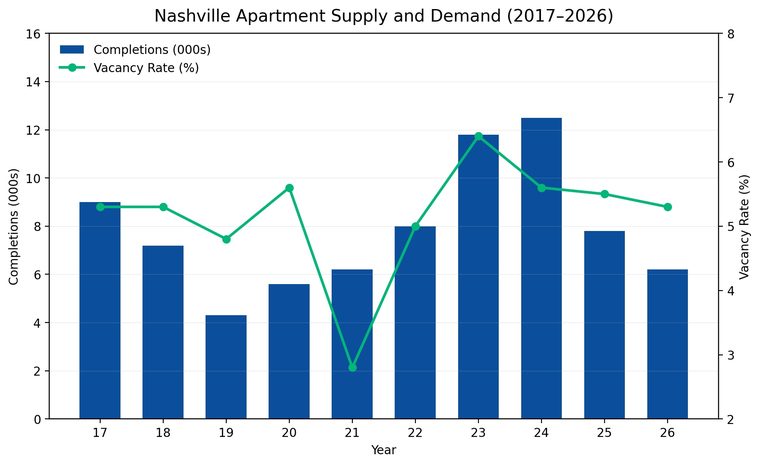
- Employment Growth: About 10,000 jobs added in 2026.
- Construction Trends: About 6,200 units projected for delivery, with inventory growth near 3.0%.
- Vacancy: Vacancy projected near 5.2%, with modest improvement expected.
Tennessee Multifamily Loan Programs
As a broker, we compare every large-balance program to find your best fit:
Recent Multifamily Loan Closings
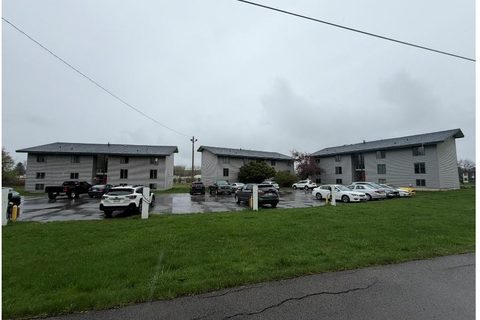
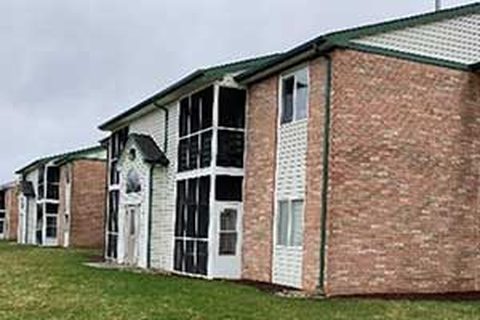
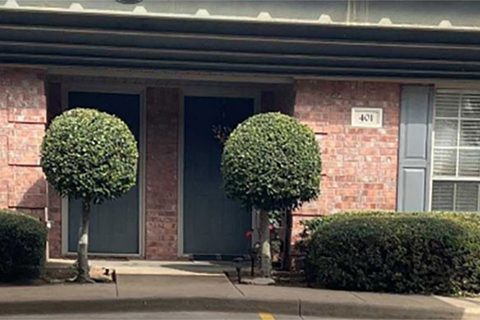
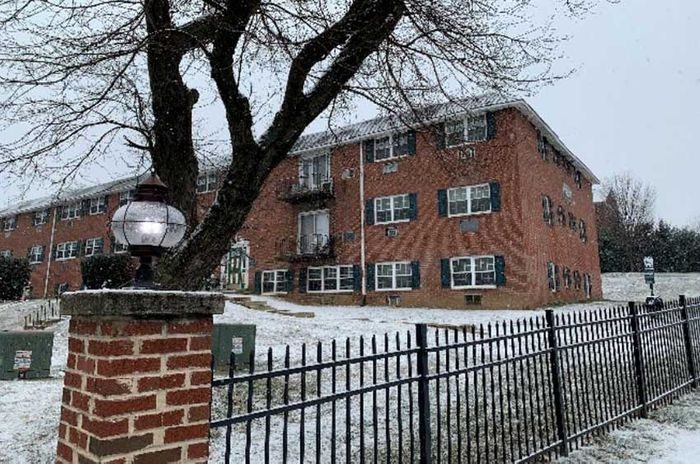
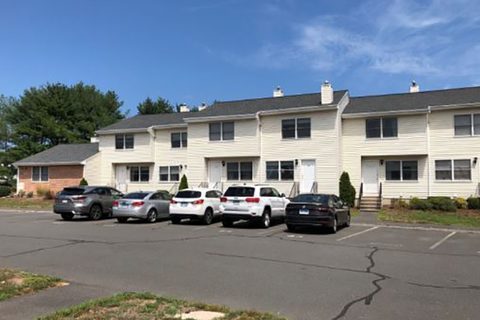
A sample of apartment and multifamily loans we have arranged for investors nationwide.
Other Property & Loan Types We Finance in Tennessee
As a full-service commercial mortgage broker, we arrange Tennessee financing across every major property and loan type:
We consider commercial loan requests of all sizes, beginning at $1,500,000.
What Our Clients Say
“As a real estate attorney, I trust that Select Commercial will deliver commercial mortgages in a timely manner. My clients are always handled professionally, and the rates and terms are excellent. I heartily recommend them.”
David S. · New York City“I spoke to several commercial lenders before finding Select Commercial. They got me a lower rate and their service was exceptional. If you need a multifamily loan, you need to talk to Stephen.”
Nathan B. · Philadelphia, PA“Select Commercial was very helpful with my multifamily mortgage. Stephen went over several options and we came up with the best lender to meet my needs. I got the funds and also lowered my payments.”
Gary M. · Portland, OR“Select Commercial offered 100% financing for my medical practice when my bank would have required 20% down. They delivered something my bank could not, and handled everything professionally.”
John C. · Boston, MAGet Your Tennessee Multifamily Loan Quote
No cost, no obligation. Written answers within 48 hours on Tennessee multifamily loans over $6,000,000.
- No application or processing fees
- Written answers within 48 hours
- For 5+ unit and commercial properties, $1.5M and up