
Wisconsin · Over $6 Million
Wisconsin Multifamily Loans
Select Commercial arranges Wisconsin multifamily loans, with rates as low as 6.14%, up to 80% LTV and non-recourse agency options. We compare Fannie Mae, Freddie Mac, FHA/HUD and CMBS. For loans under $6 million, see Wisconsin apartment loans. See current rates on every loan type we offer.
Get a Free QuoteFinancing Options in Wisconsin
Wisconsin apartment, multifamily and commercial properties each have dedicated financing. Pick the page that matches your property:
Financing more of the state? See Wisconsin apartment loans and Wisconsin commercial mortgages.
Financing in another state? Explore our apartment loans, multifamily loans and commercial mortgages nationwide.
Wisconsin Multifamily Loan Rates
Rates updated as of October 22, 2026
| Loan Type | Rate* | Max LTV |
|---|---|---|
| 5 Year Fixed | 6.14% | Up to 80% |
| 7 Year Fixed | 6.17% | Up to 80% |
| 10 Year Fixed | 6.21% | Up to 80% |
- Streamlined underwriting for institutional multifamily
- Cash-out refinances are acceptable
- Interest-only and non-recourse options
- Minimum 1.25x debt-service-coverage ratio
Wisconsin Apartment Loans
For smaller apartment building loans, under $6 million
Rates last updated October 22, 2026. Rates and maximum LTV shown represent our best-case pricing scenarios. Actual rates, LTV, and loan terms are subject to underwriting approval and may vary.
Wisconsin Apartment Building Loans
Not every Wisconsin apartment property is over $6 million, and we finance smaller buildings too. For 5+ unit Wisconsin apartment properties from $1,500,000 to $6 million, see our Wisconsin apartment loans page for Fannie Mae Small Loan, Freddie Mac SBL, bank and credit union options.
Compare Wisconsin Large-Balance Programs
As a broker we place your large-balance Wisconsin multifamily loan with the right capital source. Typical starting points for properties over $6 million:
| Program | Typical rate* | Max leverage | Best for |
|---|---|---|---|
| Fannie Mae DUS | 6.14% | Up to 80% | Non-recourse, fixed to 30 yrs |
| Freddie Mac | 6.17% | Up to 80% | Non-recourse large-balance |
| FHA / HUD | 6.74% | Up to 85% | Highest leverage, 35-yr amortization |
| CMBS / conduit | 7.03% | Up to 75% | Non-recourse, flexible underwriting |
Most large-balance lenders look for a debt-service-coverage ratio (DSCR) of at least 1.25x. For properties under $6 million, see our Wisconsin apartment loans.
Rates last updated October 22, 2026. Rates and maximum LTV shown represent our best-case pricing scenarios. Actual rates, LTV, and loan terms are subject to underwriting approval and may vary.
2026 Wisconsin Multifamily Investment and Lending Outlook
The most useful thing we found about Wisconsin multifamily finance was not a market statistic. It was a bank group.
The Greenline in Monona, a Madison suburb, is a 357-unit project with 16,000 square feet of ground-floor commercial space, under construction as of October 2026 and financed by three lenders sharing the hold: Old National Bank, Johnson Financial Group and Bank CMG.
That tells a borrower how large Wisconsin multifamily construction debt actually gets done. Not by one national lender taking the whole loan, but by regional and in-state banks clubbing together. If you are seeking a large balance here, expect a club structure and budget time for it, because three credit committees run on three calendars.
Be straightforward about the market data. Neither Milwaukee nor Madison has a current, citable multifamily cap rate, price per unit, vacancy rate, rent growth figure or absorption number from a source we would quote. The major publishers either do not cover these markets or put the figures behind registration. The national context from a comparable report is 8.9% whole-market vacancy, asking rent growth of 1.5% year over year, and 475,000 units under construction nationally, equal to 3.5% of inventory.
Practically, that means a Wisconsin appraisal leans on the income approach and on the appraiser’s private sales file, and a borrower who brings a complete rent roll, three years of operating statements and documented occupancy shortens the process.
In-state capacity is substantial. Associated Banc-Corp, headquartered in Green Bay, carried $6.49 billion of investor commercial real estate within a $9.04 billion commercial real estate book and $36.47 billion of total loans at June 30, 2026. It does not disclose a separate multifamily figure, and its balances grew sharply over the preceding two quarters in a way that reflects portfolio activity rather than organic origination, so read them as point-in-time.
Wisconsin Cannot Have Rent Control, but Your Development Agreement Can
Wisconsin is the clean inverse of Washington. Where Washington caps rent increases by statute, Wisconsin forbids any municipality from doing so. But the preemption has a carve-out that moves the entire question from statute into your deal documents, and that is where the diligence has to go.
The preemption. Wis. Stat. § 66.1015(1) provides: No city, village, town or county may regulate the amount of rent or fees charged for the use of a residential rental dwelling unit. Section 66.1015(3)(b) adds: No city, village, town, or county may enact, impose, or enforce an inclusionary zoning requirement, with inclusionary zoning defined as a regulation requiring a certain number or percentage of residential units in a development to be made available for rent or sale to households at or below a percentage of median income. The section was enacted in 1991 and amended as recently as 2021.
So trended rent and exit assumptions in Wisconsin face no statutory ceiling, and there is no regulatory-cap risk to price into an exit cap rate. For a market-rate property that is a meaningful advantage over Washington, Minnesota’s regulated municipalities, New Jersey’s patchwork and New York.
Now the carve-out, and it is the whole point. Section 66.1015(2) permits a city, village, town, county, housing authority or the Wisconsin Housing and Economic Development Authority to regulate rent by (a) entering a rental agreement for a unit it owns or operates, or (b) entering an agreement with a private person who regulates rent or fees charged for a residential rental dwelling unit.
Read subsection (2)(b) carefully. Rent restrictions that an owner agreed to are fully enforceable notwithstanding the preemption. A tax increment financing development agreement, a state housing authority loan, a land write-down, a payment-in-lieu arrangement or a municipal incentive package can all carry rent and income restrictions that bind the property and every subsequent owner, and the statute that bars rent control does nothing to them.
So in Wisconsin, rent-restriction risk is contractual and deal-specific rather than statutory. The underwriting task is not checking for an ordinance that cannot legally exist. It is reading the development agreement and every municipal or housing authority agreement of record against the property, confirming the remaining term of any restriction, and confirming whether it survives transfer and foreclosure. On a property that took public money at any point in its history, that is the first document to request, ahead of the rent roll.
Two more Wisconsin features that affect the numbers.
Your purchase price invites a reassessment. Under Wis. Stat. § 70.32(1), real property is valued by the assessor in the manner specified in the Wisconsin Property Assessment Manual, from actual view or from the best information the assessor can practicably obtain, at the full value which could ordinarily be obtained therefor at private sale, and the assessor must consider recent arm’s length sales of the subject property where they conform to professionally acceptable appraisal practice.
Because the standard is full value at private sale and the subject property’s own recent sale is an expressly named input, a Wisconsin apartment acquired above its prior assessment should expect reassessment toward the purchase price. Underwrite year-one property taxes off what you paid, not off the seller’s bill. On a $25,000,000 purchase of a property last assessed at $15,000,000, that step-up is the largest single swing item in the expense underwriting and the most common reason a Wisconsin pro forma misses in its first year. Confirm with the municipal assessor how your property is classified and when values are next set, since practice varies.
And Wisconsin charges nothing to record your mortgage. Under Wis. Stat. § 77.22 there is a real estate transfer fee at the rate of 30 cents for each $100 of value or fraction thereof, 0.30%, on every conveyance not exempted, imposed on the grantor, with the return signed by both grantor and grantee on the Secretary of Revenue’s prescribed form. On a $25,000,000 purchase that is $75,000 on the deed.
The cost sits entirely on the conveyance rather than on the loan, which makes Wisconsin materially cheaper than a mortgage recording tax state for putting on new debt, increasing a loan, taking supplemental financing or refinancing. Compare Alabama at fifteen cents per $100 of indebtedness uncapped, Tennessee at eleven and a half cents uncapped, or Maryland where a $20,000,000 loan can carry $230,000 in recordation tax by itself. Wisconsin puts the cost on the sale instead.
One closing-mechanics item that catches people. The statute provides that submission of the completed return and payment of the fee are prerequisites to acceptance of the conveyance for recording, and the register of deeds enters the fee on the face of the instrument before recording. The transfer return therefore sits on the critical path to recording the deed, and so to recording your mortgage behind it. It is a small form with the power to delay a closing.
Finally, if your project involves tax increment financing, note that under Wis. Stat. § 66.1105(4) a district may be created only if the equalized value of taxable property in the proposed district, plus the value increment of all existing districts, does not exceed twelve percent of the municipality’s total equalized value. In communities that have used the tool heavily there is no capacity left, which is a feasibility question to settle before a development budget relies on it.
2026 Wisconsin Multifamily Metro Snapshots
A look at the Wisconsin metros we most actively finance, with 2026 market indicators and the local supply and demand picture:
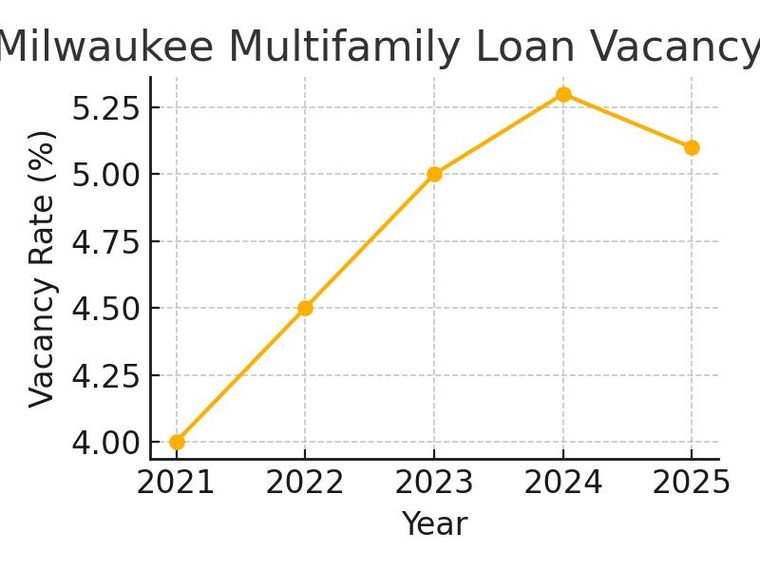
- The metro sheds 8,000 jobs, among the largest losses nationally.
- Deliveries drop to the lowest level since 2013, with the CBD off 85 percent.
- Vacancy edges down to 3.6 percent, below the prior decade average.
Wisconsin Multifamily Loan Programs
As a broker, we compare every large-balance program to find your best fit:
Recent Multifamily Loan Closings
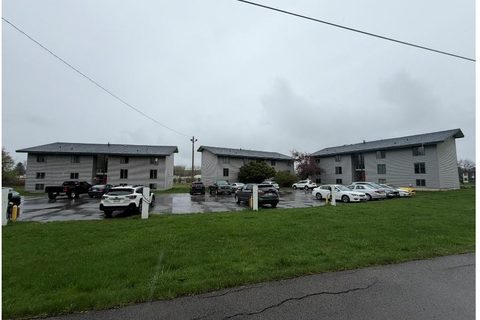
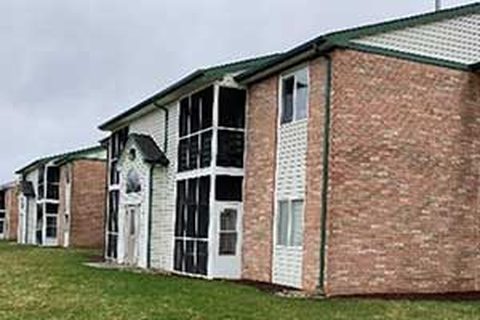
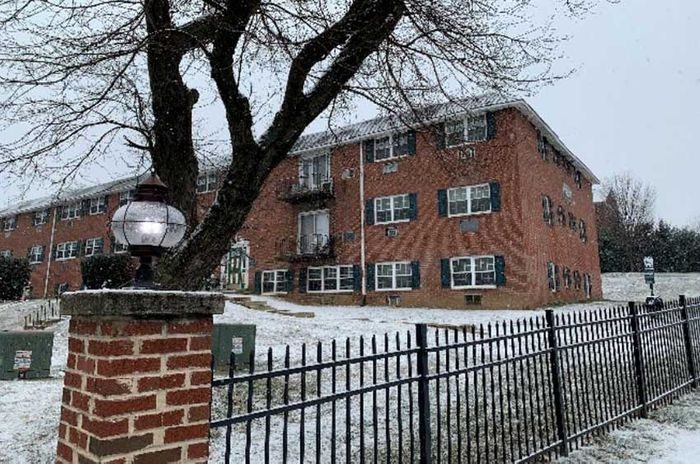
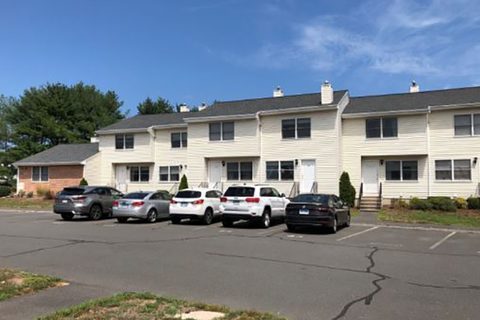
A sample of apartment and multifamily loans we have arranged for investors nationwide.
Other Property & Loan Types We Finance in Wisconsin
As a full-service commercial mortgage broker, we arrange Wisconsin financing across every major property and loan type:
We consider commercial loan requests of all sizes, beginning at $1,500,000.
What Our Clients Say
“As a real estate attorney, I trust that Select Commercial will deliver commercial mortgages in a timely manner. My clients are always handled professionally, and the rates and terms are excellent. I heartily recommend them.”
David S. · New York City“I spoke to several commercial lenders before finding Select Commercial. They got me a lower rate and their service was exceptional. If you need a multifamily loan, you need to talk to Stephen.”
Nathan B. · Philadelphia, PA“Select Commercial was very helpful with my multifamily mortgage. Stephen went over several options and we came up with the best lender to meet my needs. I got the funds and also lowered my payments.”
Gary M. · Portland, OR“Select Commercial offered 100% financing for my medical practice when my bank would have required 20% down. They delivered something my bank could not, and handled everything professionally.”
John C. · Boston, MAGet Your Wisconsin Multifamily Loan Quote
No cost, no obligation. Written answers within 48 hours on Wisconsin multifamily loans over $6,000,000.
- No application or processing fees
- Written answers within 48 hours
- For 5+ unit and commercial properties, $1.5M and up