Colorado Multifamily Loan Rates
| CO Multifamily Loan Rates More Than $6 Million | Free Loan Quote | ||
|---|---|---|---|
| Loan Type | Rate* | LTV | |
| Multifamily Loan 5 Yr Fixed | 5.30% | Up to 80% | |
| Multifamily Loan 7 Yr Fixed | 5.34% | Up to 80% | |
| Multifamily Loan 10 Yr Fixed | 5.40% | Up to 80% | |
*Rates start as low as shown and are based on underwriting criteria, borrower experience, and property strength.
Ready to get started? Click here to request a customized loan quote for your Colorado multifamily property.
Need a loan under $6 million? Visit our Colorado apartment loan page. For other commercial property types, explore our Colorado commercial mortgage options. To compare all rates nationwide, see commercial mortgage rates.
Why Choose Select Commercial for Multifamily Loans
What sets Select Commercial apart from traditional lenders and large banks? In this short video, we highlight the key reasons multifamily building investors choose to work with us for Colorado multifamily loans over $6 million. We also actively finance apartment building loans below $6 million.
Here’s what the video touches on:
- No upfront application or processing fees
- Fast written pre-approvals often within 24 hours
- Access to a wide range of multifamily lenders, not just one bank
- Loan structures tailored to your property and investment goals
2026 Colorado Multifamily Loan Market Overview
Entering 2026, Colorado presents a transitional but improving environment for Colorado multifamily loans. The state continues to benefit from long-term population growth, strong household income levels, and barriers to homeownership that support renter demand. However, near-term performance is still being shaped by elevated vacancy in Denver and a market that is working through a significant development cycle from prior years.
For borrowers working with Colorado multifamily lenders, this creates a more nuanced lending environment. Deals are still getting done across acquisitions, refinances, and recapitalizations, but underwriting has shifted toward in-place income, occupancy stability, and realistic rent growth assumptions. As new construction slows, the overall market is moving toward a more balanced supply-demand dynamic.
Denver Sets the Tone for Colorado Multifamily Loans
Denver remains the dominant driver of multifamily performance across Colorado and serves as the primary benchmark for lenders and investors. In 2026, the metro is projected to add about 8,000 jobs, deliver roughly 6,000 units, and maintain vacancy near 6.0%, with average effective rent around $1,825 per month.
For sponsors evaluating multifamily financing, Denver offers the largest inventory base, the most liquidity, and the deepest lender participation. At the same time, elevated vacancy requires disciplined underwriting, particularly for assets that depend on lease-up velocity or aggressive rent assumptions.
Construction Is Falling Meaningfully in Colorado
One of the most important shifts for Colorado multifamily lenders is the sharp reduction in new deliveries. Denver is expected to bring more than 3,000 fewer units online compared to the prior year, with inventory growth of about 1.7%, significantly below historical averages.
This decline in construction activity is critical for restoring balance. As fewer new units enter the market, existing multifamily properties face less competitive pressure, allowing occupancy to stabilize and rent performance to improve over time.
Rent Improvement Returns After Prior Softness
Colorado rent trends are beginning to stabilize after a period of softness driven by elevated supply. Denver average effective rent is projected to increase approximately 2.1% in 2026, reaching around $1,825 per month. This marks a shift from declining or flat rent conditions seen in prior years.
For borrowers utilizing multifamily commercial real estate loans, this improving rent trajectory supports more stable income projections. However, lenders are still cautious and generally underwrite to in-place rents rather than forward-looking growth.
Vacancy Still Requires Careful Underwriting
Despite improving conditions, vacancy remains elevated relative to many top-performing multifamily markets. Denver vacancy is projected near 6.0%, which continues to influence lender underwriting standards and loan structuring.
For borrowers pursuing Colorado multifamily loans, this means a greater focus on occupancy history, tenant retention, and operational performance. Properties that demonstrate stability are more likely to secure favorable loan terms in the current cycle.
2026 Colorado Multifamily Loan Market Forecast
- Employment: Denver is projected to add about 8,000 jobs in 2026.
- Construction: Deliveries are declining significantly, down by more than 3,000 units from the prior year.
- Vacancy: Vacancy remains elevated near 6.0% but is expected to stabilize.
- Rent: Average effective rent is projected near $1,825, with modest annual growth.
For investors evaluating Colorado multifamily loans, 2026 represents a normalization phase. Denver remains the anchor market, while improving rent trends and declining supply help offset elevated vacancy. This creates a clearer environment for borrowers working with Colorado multifamily lenders to structure long-term investments.
2026 Denver Colorado Multifamily Loan Market Overview
Denver continues to serve as the primary hub for Colorado multifamily loans, offering the largest inventory base and the most active lending environment in the state. The market is defined by strong long-term demand drivers combined with short-term supply pressure from recent development cycles.
Denver Colorado Multifamily Loan Rates and Financing in 2026
Financing conditions remain active but selective. Borrowers seeking a Denver multifamily loan will find that lenders are prioritizing stabilized assets, strong in-place income, and conservative underwriting assumptions. Deals involving lease-up risk or heavy repositioning may require more structured financing solutions.
Interest rates and loan terms vary depending on asset performance, but overall liquidity remains strong for qualified borrowers working with Colorado multifamily lenders.
Trends in the Denver Colorado Multifamily Loan Market
The Denver market is currently transitioning through a reset period. Slower population growth, reduced migration, and elevated supply have impacted short-term performance, but declining construction is expected to improve fundamentals over time.
This creates opportunities for investors who can navigate current conditions and position assets for long-term recovery.
Denver Colorado Multifamily Loan Rent Levels in 2026
Average effective rent in Denver is projected near $1,825 per month, reflecting a return to modest growth following a period of decline. Rent stabilization is a key factor in restoring confidence among Colorado multifamily lenders.
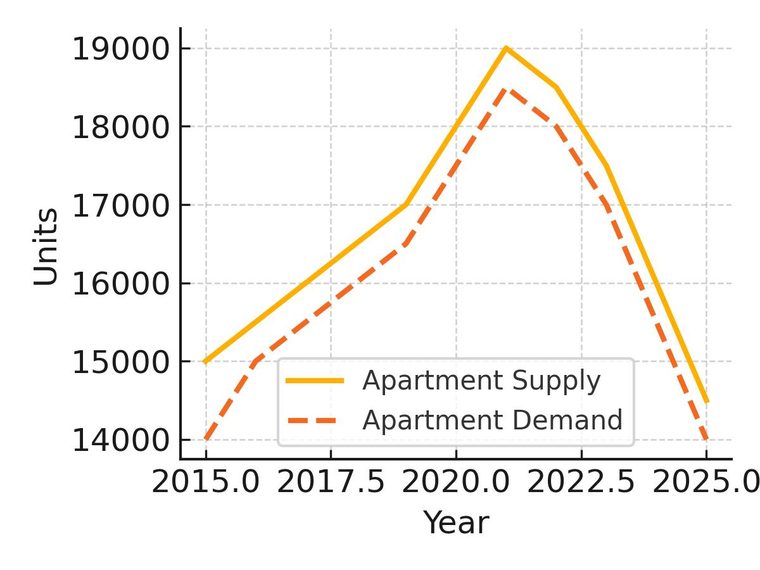
Denver Colorado Multifamily Loan Supply and Demand
Supply remains elevated but is declining, with new deliveries dropping significantly from prior years. Demand continues to absorb existing inventory, although at a slower pace than during peak growth periods.
This gradual rebalancing is a critical factor for borrowers pursuing multifamily financing in Denver.
Opportunities for Multifamily Investment in Denver Colorado
Investors are focusing on stabilized assets, properties with improving occupancy, and opportunities where rent growth can be captured as market conditions normalize. Denver remains one of the most important long-term multifamily markets in the region.
2026 Colorado Springs Colorado Multifamily Loan Market Overview
Colorado Springs provides a strong secondary market for Colorado multifamily loans, supported by population growth, solid household income levels, and a more moderate pricing environment compared to Denver.
Colorado Springs Colorado Multifamily Loan Rates and Financing in 2026
Borrowers seeking a Colorado Springs multifamily loan benefit from a more conservative underwriting environment, where lower acquisition costs support stronger debt service coverage and more stable financing structures.
This makes the market attractive for investors focused on steady income rather than aggressive rent growth.
Trends in the Colorado Springs Colorado Multifamily Loan Market
Colorado Springs continues to attract investors due to its affordability and steady demand profile. The market provides diversification within Colorado and helps reduce reliance on Denver-specific conditions.
Colorado Springs Colorado Multifamily Loan Rent Levels in 2026
Median rent near $1,648 reflects a lower-cost tier within Colorado, which can appeal to investors targeting workforce housing and stable occupancy.
Colorado Springs Colorado Multifamily Loan Supply and Demand
Supply levels are more moderate compared to Denver, allowing for more balanced occupancy trends and consistent renter demand.
Opportunities for Multifamily Investment in Colorado Springs Colorado
Opportunities in Colorado Springs are often centered on stabilized properties and value-oriented acquisitions that benefit from steady tenant demand and lower pricing.
2026 Aurora Colorado Multifamily Loan Market Overview
Aurora adds depth to the Colorado multifamily market as part of the broader Denver metro area, offering strong population scale and competitive rent levels.
Aurora Colorado Multifamily Loan Rates and Financing in 2026
Borrowers evaluating an Aurora multifamily loan can access a wide range of financing options, supported by strong lender familiarity with the Denver corridor.
Trends in the Aurora Colorado Multifamily Loan Market
Aurora continues to benefit from regional growth and provides a balance between Denver pricing and suburban demand.
Aurora Colorado Multifamily Loan Rent Levels in 2026
Median rent near $1,835 positions Aurora between Denver and Colorado Springs, creating a flexible investment profile.
Aurora Colorado Multifamily Loan Supply and Demand
Demand remains strong due to population growth and proximity to employment centers, while supply pressures are gradually easing.
Opportunities for Multifamily Investment in Aurora Colorado
Investors often target Aurora for its combination of scale, accessibility, and pricing, making it a strong complement to Denver-focused strategies.
What Lenders Look for in a Colorado Multifamily Loan
Before you apply for a Colorado Multifamily loan, it helps to understand what lenders are actually evaluating. In this short video, Select Commercial President Stephen Sobin outlines the key borrower and property qualifications that influence approval.
Watch to learn:
- What makes a loan request stand out or get rejected
- The importance of cash flow, occupancy, and borrower experience
- Which documents lenders require to issue a pre-approval
Understanding Your Multifamily Loan Options
Not all multifamily loans are created equal. In this short video, Stephen Sobin explains the most common types of multifamily loan programs and when each one makes the most sense for Colorado borrowers.
- Bank vs. agency vs. private multifamily lenders
- Short-term vs. long-term fixed-rate options
- How to structure your loan based on your property and investment goals
Our Colorado Multifamily Loan Process
We make applying for a Colorado multifamily loan fast, transparent, and cost-effective. Our process is designed for borrowers seeking large balance multifamily financing backed by experienced multifamily lenders. Below is a step-by-step overview of what to expect when working with Select Commercial:
Step 1: Initial Screening
During an introductory call or email, we gather the basics of your transaction. If the request doesn’t meet multifamily loan guidelines, we’ll let you know right away.
Step 2: Document Request
If eligible, we’ll send a short checklist to review your financials, credit, and property cash flow. This helps us evaluate your multifamily commercial real estate loan scenario.
Step 3: Underwriter Review
Once documents are received, underwriting begins. If your multifamily loan qualifies, we issue a written pre-approval. If not, we’ll explain why.
Step 4: Pre-Approval Letter
If approved, we send a detailed pre-approval letter outlining preliminary terms and any additional documentation needed.
Step 5: Third-Party Reports
Once pre-approved, the underwriter orders the appraisal and other required third-party reports. A good faith deposit is collected to cover these costs.
Step 6: Final Submission
Once all documentation and reports are in, underwriting is finalized and a formal multifamily loan commitment is issued.
Step 7: Legal & Closing
Our legal team prepares the closing checklist and any final conditions. Once satisfied, we move forward with closing.
Step 8: Timeline
Most multifamily loans close within 30 to 60 days, depending on deal complexity and how quickly documents are submitted.
Multifamily Property Types We Finance in Colorado
At Select Commercial, we provide multifamily financing for a broad range of Colorado multifamily properties, from stabilized 5+ unit buildings to large-scale portfolios. Whether your asset is urban, suburban, or mixed-use, we tailor each multifamily commercial real estate loan to match your investment strategy and property type.
- Urban mid-rise and high-rise multifamily buildings
- Suburban garden-style multifamily complexes
- Small multifamily buildings with 5+ units
- Mixed-use properties with residential and limited commercial space
- Underlying co-op building loans
- Portfolios of small multifamily or single-family rental properties
- Stabilized properties with solid cash flow and rent history
If you're unsure whether your property qualifies for a multifamily loan, contact us for a free quote and we'll review your deal within 24 hours.
Recent Multifamily Loan Closings
Our Reviews
Latest Expert Insights from Stephen A. Sobin
Stephen A. Sobin, the president of Select Commercial Funding LLC, is a renowned expert in the field of multifamily financing. His insights and perspectives are regularly sought by leading industry publications. Here are his latest contributions that highlight his deep understanding of the multifamily financing landscape and his commitment to providing clear, insightful analysis on key industry issues.
Navigating Opportunity, Risk as 2025 Winds Down
In an article for Commercial Property Executive titled "Navigating Opportunity, Risk as 2025 Winds Down", Sobin explains as we head into the final stretch of 2025, the commercial real estate industry stands at a pivotal moment. After several years of upheaval—from pandemic disruptions to aggressive Federal Reserve rate hikes and lasting shifts in how people live and work—the sector is entering a new phase.
Why Lower Rates Haven't Fixed Commercial Real Estate
In an article for Wealth Management titled "Why Lower Rates Haven't Fixed Commercial Real Estate", Sobin explains that even as the Federal Reserve has begun cutting rates and borrowing costs should be falling, the commercial real estate sector remains locked in a frustrating stalemate. For high-net-worth investors trying to time the market, he emphasizes that understanding this disconnect requires looking beyond the headlines.
Why the Fed Rate Cut’s a Game Changer for CRE
In an article featured in Multi-Housing News, Stephen Sobin highlighted that after months of speculation and market anticipation, the Federal Reserve finally pulled the trigger last week, cutting the federal funds rate by 25 basis points to 4.00 to 4.25 percent. read the full article.
Inflation's Current Impact on Apartment
In an article featured in Multi-Housing News, Sobin explains how commercial mortgage rates continue to challenge investors, with elevated inflation depressing real estate market activity. Read the full article.
Will the July Jobs Report Pressure the Fed to Act?
Sobin noted in Multi-Housing News that unemployment hit a three-year high and job creation slowed significantly, factors that could push the Fed to reconsider future rate hikes. Read the full article.
Persistent Inflation and Its Effects on CRE
In an article featured in Multi-Housing News, Stephen Sobin highlighted that while inflation is still a challenge for the Federal Reserve, there are many positive signs for the commercial real estate industry. The headline Consumer Price Index rose 3.2 percent for the year ended Feb. 29, a figure 20 basis points lower than the Dec. 31, 2023, rate. read the full article.
Commercial Spotlight: Mid-Atlantic Region In this four-state powerhouse, smaller metros are thriving.
In a feature in Scotsman Guide, the Mid-Atlantic Region's real estate dynamics are explored, highlighting its resilience and growth amidst the pandemic.
Stephen Sobin of Select Commercial Funding LLC shared insights on the New York market's allure and the challenges buyers face. He noted the shift from primary urban areas to tertiary markets due to evolving preferences and financial conditions. For a deeper dive into Sobin's analysis, read the full article.
What the New Jobs Report Means for CRE
In an article titled "What the New Jobs Report Means for CRE" in Commercial Property Executive, Stephen Sobin shared his perspective on the latest jobs report and its implications for the Commercial Real Estate (CRE) sector. He highlighted the challenges posed by high interest rates and the prevailing uncertainty in the market. Sobin remarked, "Sellers aren’t selling, buyers aren’t buying... Everyone is waiting because no one knows what to expect." For a detailed analysis and more of Sobin's insights, read the full article.
Decoding "Junk Fees" in Rental Housing
In another latest contribution to Multi-Housing News, Sobin provided expert commentary in an article titled "What's Next for Junk Fees? The Industry Weighs In". He clarified the difference between legitimate fees collected for various third-party services and so-called "junk fees". Sobin emphasized the importance of borrowers understanding their rights in negotiating all loan terms and the obligation of lenders to disclose all fees.
Understanding the Impact of Federal Reserve's Decisions
In a recent article titled "How the Fed's Pause on Interest Rates Impacts Multifamily" published by Multi-Housing News, Sobin shared his expert insights on the Federal Reserve's decision to pause interest rate hikes. He accurately predicted that the Fed would not raise rates in June, citing recent bank failures and lingering concerns about a potential recession.
Stay tuned for more expert insights from Stephen A. Sobin on the evolving multifamily financing landscape.
Frequently Asked Questions About Colorado Multifamily Loans
Multifamily loan rates in Colorado depend on several factors including loan size, property condition, borrower strength, and leverage. As of 2025, interest rates remain elevated due to persistent inflation, but high-quality borrowers with strong assets can still secure competitive terms. For other property types, view our latest commercial mortgage rates for updates.
Lenders generally require a DSCR of 1.25 or better, strong borrower credit, relevant experience, and post-closing liquidity. For large balance multifamily commercial real estate loans, loan-to-value ratios typically range from 65% to 80%, depending on cash flow.
Large balance multifamily financing requires tailored solutions. Select Commercial works with a wide range of capital sources, including banks, life companies, CMBS, agency, and private lenders, giving you access to more options, better terms, and higher certainty of execution.
The process begins with a review of property-level financials, including a current rent roll, trailing 12-month operating statement, borrower net worth, liquidity, and experience. Our team quickly assesses eligibility and provides a pre-approval when qualified. Start with a Free Quote today.
Select Commercial also specializes in loans under $6 million. If you're refinancing a smaller apartment loan, we can help structure multifamily financing with competitive rates and flexible terms. Visit our Colorado apartment loan page for details.
Agency Large‑Balance Multifamily Loan Programs (Over $6 Million)
Select Commercial connects borrowers with premier agency-backed large-balance multifamily loan programs, perfect for financing institutional-scale properties across Colorado and beyond.
- Fannie Mae® Multifamily (DUS® platform) – Large‑balance non‑recourse multifamily financing, including fixed, floating, hybrid‑ARM, and interest‑only options
- Freddie Mac® Multifamily – Comprehensive large‑balance multifamily financing (fixed and floating) with up to $250 M in loan capacity
These agency programs offer non‑recourse structures, competitive fixed or floating rates, strong leverage (typically up to ~80 % LTV), and streamlined execution, ideal for experienced investors pursuing well‑performing multifamily assets.
Looking for loans under $6 million? Visit our dedicated Colorado apartment loan page for smaller-balance financing options.
Colorado Multifamily Financing
Select Commercial provides multifamily loans and Colorado commercial mortgages throughout the state of Colorado including but not limited to the areas below.